Fixing the Coordination Gap in Real-Time Logistics

Operational delays are not always avoidable.
But reacting late to them is.
For dispatchers, fleet managers, and operations leaders, the real damage often starts when a delay is discovered too late. A dispatcher learns about a 40-minute idle stop only when the customer calls. A fleet manager sees the missed delivery window after the route is already behind. An operations leader hears about the issue after it has become an escalation.
In most logistics and field operations, delays do not become visible until they have already caused downstream impact: missed delivery windows, idle time at stops, or customer escalations. The issue is not a lack of data. Modern fleets already generate continuous streams of location data from GPS devices, mobile apps, and telematics systems.
The real problem is coordination.
The Hidden Gap in Logistics Systems
Today's logistics stack is usually fragmented:
- GPS tracking lives in one system.
- Dispatch and routing live in another.
- Alerts and notifications are handled separately.
- Integrations with downstream systems are often manual or delayed.
Things change in the real world all the time: a vehicle arrives, deviates from a route, or sits too long at a stop. That event rarely triggers immediate action across the rest of the stack.
Teams are left to monitor dashboards manually, investigate issues after the fact, and coordinate response across disconnected tools.
That creates operational lag between event -> awareness -> action.
In logistics, that lag is where inefficiency lives.
What Real-Time Operational Awareness Looks Like
Closing the gap between events and actions is what allows logistics systems to respond as operations change in real time.
A Unified Operational View
Instead of switching between tools, teams need one place to see:
- Live vehicle locations
- Current status (en route, at stop, delayed)
- Historical movement and route context
- Active alerts and exceptions
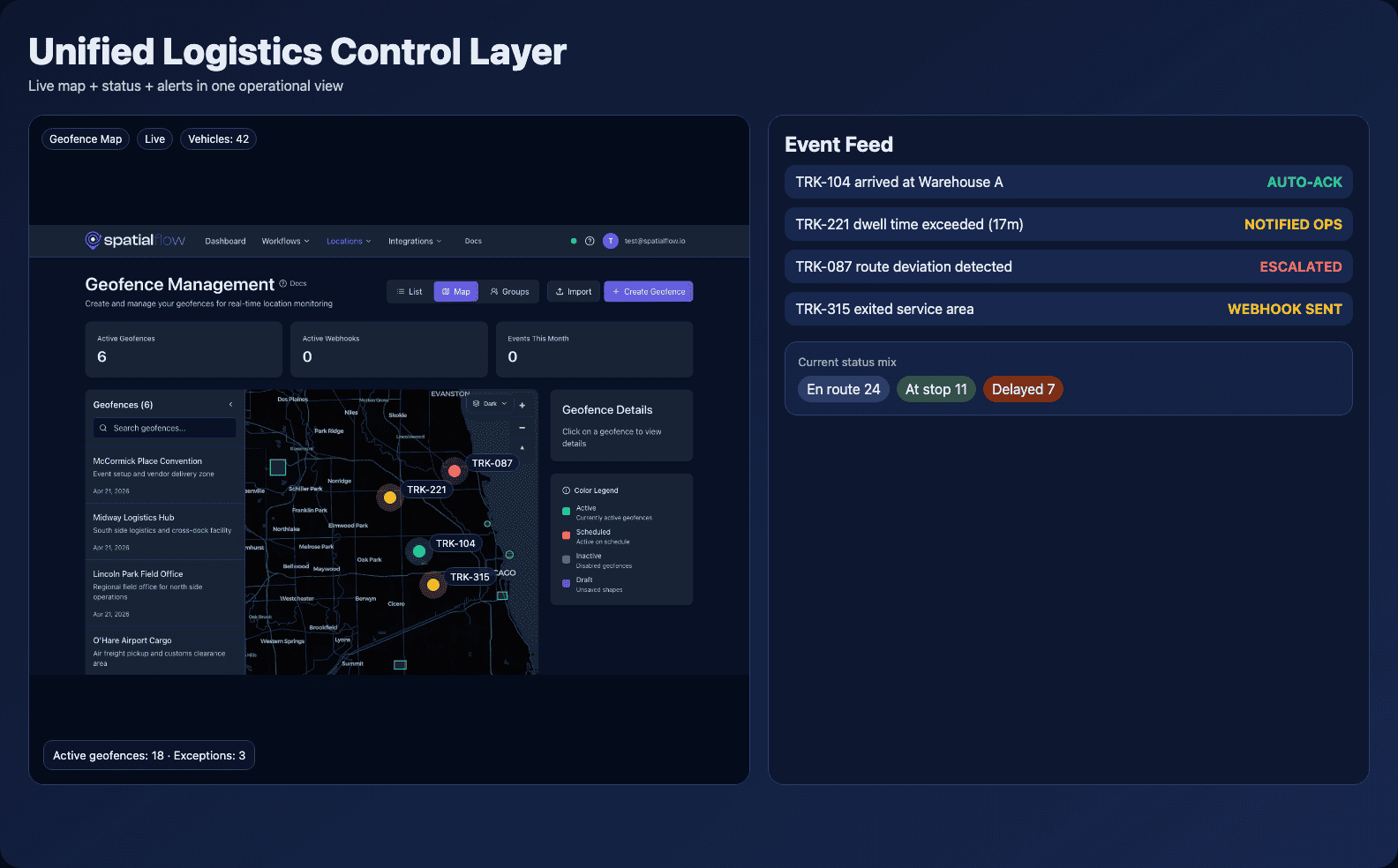
This is the operational control layer teams act from.
Event-Driven Awareness
Logistics is driven by events, not isolated data points.
Examples of critical events:
- A vehicle enters or exits a geofenced location
- A stop exceeds expected dwell time
- A route deviation occurs
- A device goes offline
These are meaningful operational changes, but only if they are detected and interpreted in real time.
Geofencing as the Foundation
Geofencing gives teams context for raw location streams.
By defining boundaries around delivery locations, warehouses, and service areas, operations teams can detect arrivals, departures, and dwell time. These events form the foundation for route-aware workflows and other higher-level automation built on top of the event layer.
SpatialFlow already handles this layer. Connect your devices, draw geofences around your delivery stops, depots, and service zones, and SpatialFlow fires geofence_enter, geofence_exit, and geofence_dwell events in real time. No custom location infrastructure required.
Automated Workflows
Once events are detected, the next step is automation.
Instead of relying on manual follow-up, systems should:
- Trigger workflows as soon as conditions are met
- Execute actions immediately
- Coordinate updates across systems
For example:
When a vehicle arrives, update delivery status. When dwell exceeds a threshold, notify operations. When a route deviation occurs, trigger an alert.
A concrete SpatialFlow workflow: a delivery vehicle enters a stop geofence, geofence_enter fires, a webhook updates your dispatch system with the arrival timestamp and an alert goes to the operations team. No polling. No manual status entry. The same workflow handles missed stops: if geofence_enter never fires within the expected window, SpatialFlow can trigger an exception alert automatically.
Real-Time Messaging and Updates
Operational awareness matters only when the right people and systems receive it in time.
When a vehicle enters a delivery geofence, exits a depot, dwells too long at a stop, or misses an expected arrival window, SpatialFlow can send an event message to the systems and teams that need to act.
For example, a dwell event might send a webhook with a geofence_id and device_id. Once those are mapped to your stop, vehicle, and driver records using custom payload templates or downstream systems, the event can include arrival time, dwell duration, location, and status. That message can notify a dispatcher, update a transportation management system, trigger a customer notification, or create an exception record for follow-up.
This keeps teams informed without manual monitoring, and keeps downstream systems synchronized as movement events happen.
From Reactive to Proactive Operations
Most logistics operations today are still reactive. Teams respond after delays happen, customers escalate, or reports are reviewed.
With real-time event detection and automation, operations become proactive:
- Issues are identified as they happen
- Immediate actions follow without manual intervention
- Teams no longer need constant monitoring and can focus on exceptions
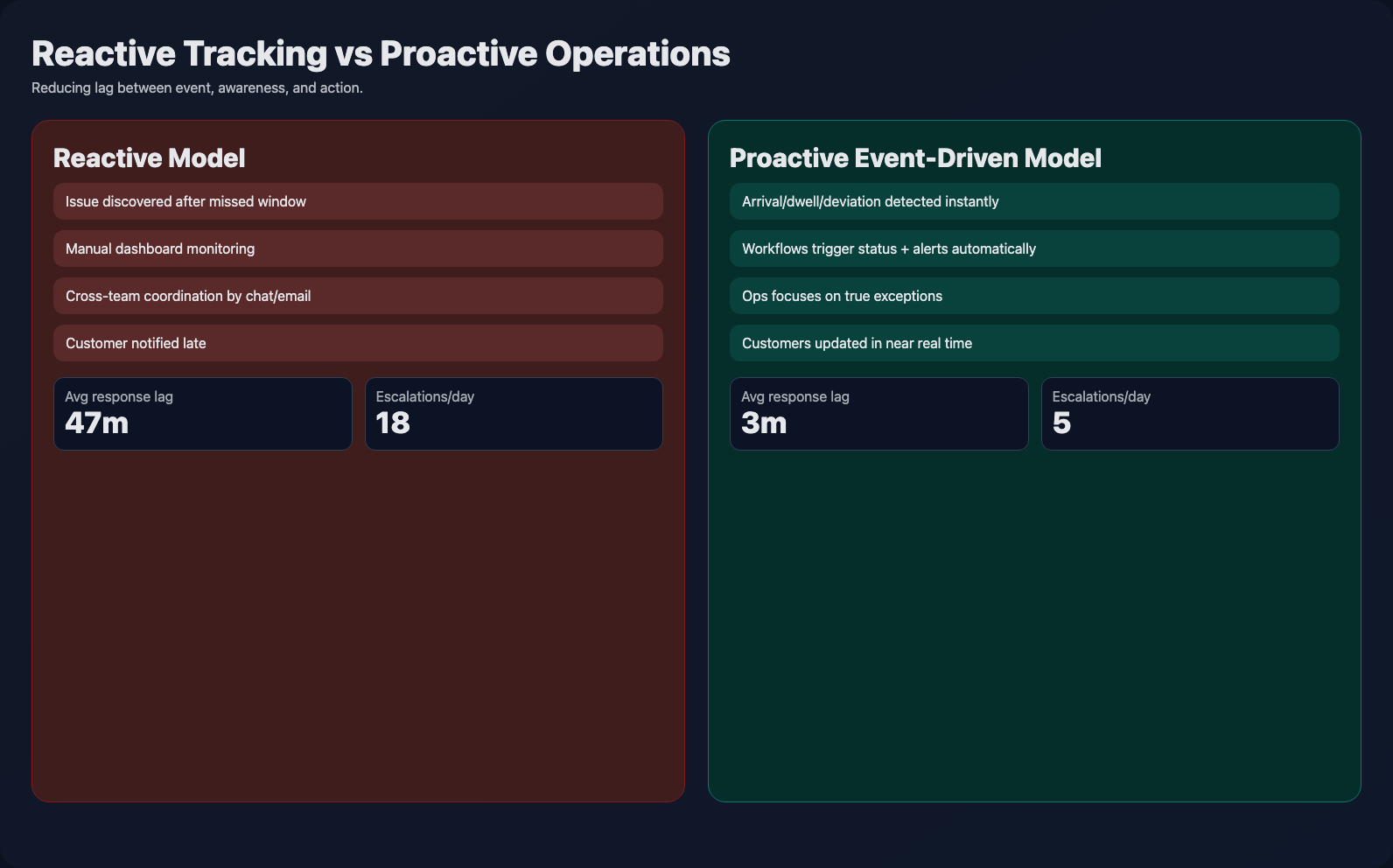
Why an Event Layer Matters: and How SpatialFlow Provides One
What many logistics stacks are missing is an event layer between raw location data and operational workflows.
Without that layer, teams often rebuild the same glue code over and over: scripts that check GPS points, cron jobs that look for missed arrivals, custom rules for dwell time, one-off webhook handlers, and fragile integrations that are hard to maintain as operations scale.
SpatialFlow is built to provide that event layer.
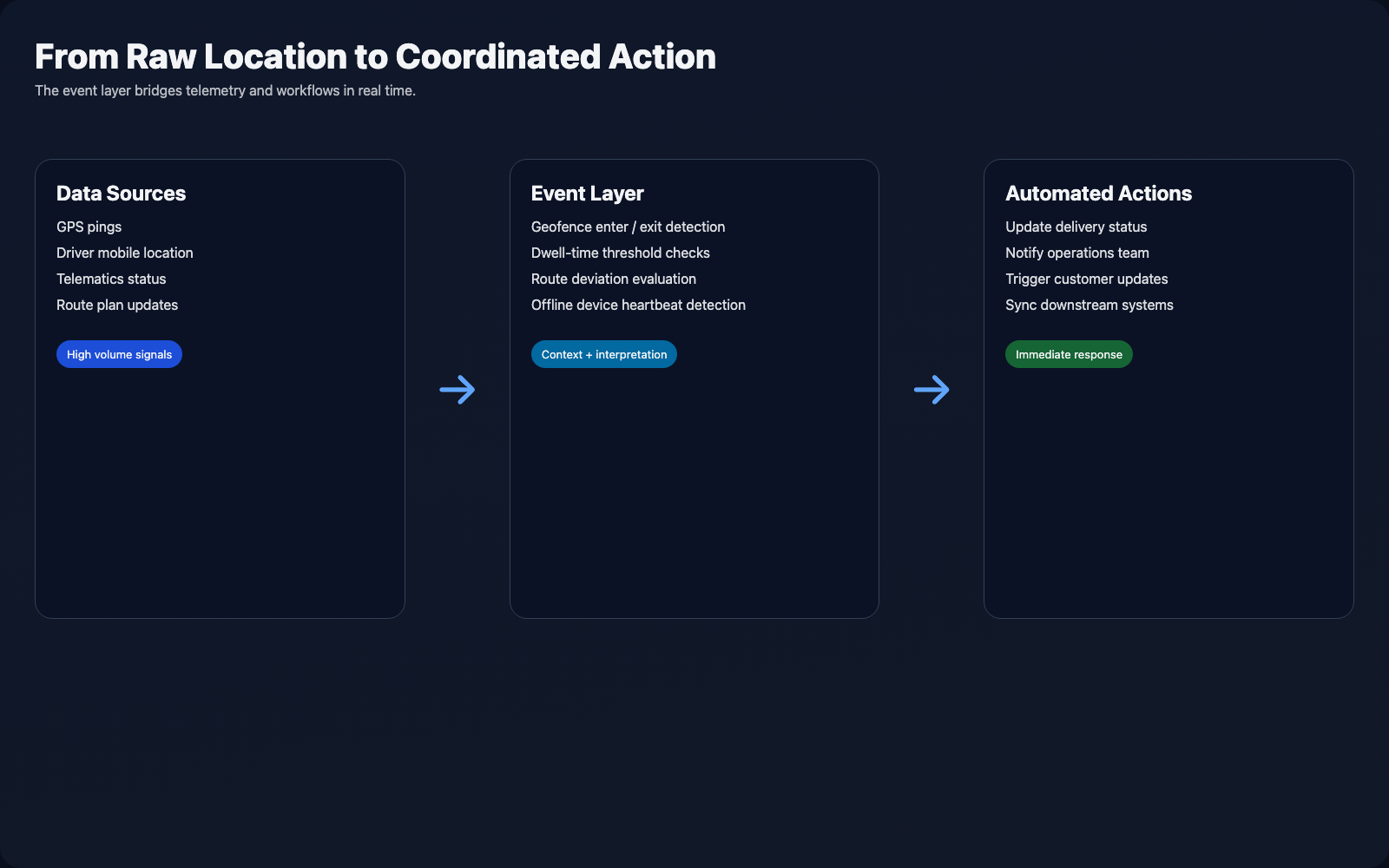
Instead of treating location data as something to store and analyze later, teams can use it to drive immediate operational response.
Turning Movement into Action
Logistics is fundamentally about movement.
But movement alone is not valuable unless it drives outcomes:
- Deliveries are completed on time
- Efficiency improves across operations
- Customers are kept informed proactively
SpatialFlow already handles the event layer: geofences, arrivals, dwell, missed stops, alerts, and webhook delivery to whatever systems your team runs. Routing-aware workflows are a natural next step, and we are actively looking for logistics teams to help shape where that belongs.
If you are working on last-mile delivery, dispatch coordination, yard or depot management, or fleet visibility and currently handling any of this manually, we want to hear from you.
Design partners: We are looking for logistics and dispatch teams to work with us directly.
- Have a workflow you handle manually? Send it to us
- Want to try it yourself? Start a free workspace
- Building as a developer? Quick Start and wire up a
geofence_dwellworkflow in five minutes